
Free Will
and the one who seems to have it

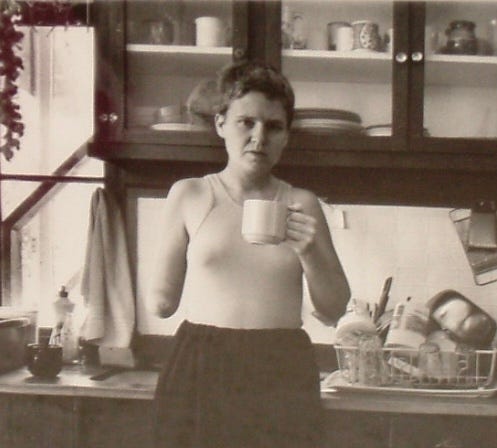
That person in the photo is “Joan Tollifson” many decades ago, or so we say, and indeed, there are some recognizable similarities between that person and the person called “Joan Tollifson” who is right now typing these words. The right hand and forearm are missing on both, and certain features, postures and facial expressions are perhaps more or less the same, so there’s enough of a pattern that people who knew “Joan Tollifson” back then will often recognize the person presently typing these words as “Joan Tollifson” now, even if they haven’t seen that person for many years. And “I” (speaking as Joan Tollifson) have sometimes pointed at that photo and said, “That was me many years ago.”
But in fact, every cell in that body has been replaced. The body has aged, its thoughts and opinions have changed many times, the activities it engages in have changed, it has seen things and been through all kinds of experiences since then. It now weighs more and is several inches shorter, the breasts have sagged, an ostomy has been added to the belly and a hernia from the colostomy has expanded that belly quite a bit. The face is more lined and has many more old age spots, the neck is flabby and wrinkled. The hair is now white and the teeth are not as straight or as close together.
Actually, the bodymind is nothing but continuous change. That coffee cup Joan is holding, once the person’s favorite, has long since broken and disappeared. And everything in the photograph is also in a process of disintegration, much of it already long gone. A photograph is like a still frame in a movie, in which a rushing stream is frozen into apparent permanence and solidity. But the reality is thorough-going flux, birth and death, instant by instant.
Where in all this infinitely varied but inseparable and undivided streaming is “me”?
In each instant, things are as they are and cannot be any different. Whatever one perceives, thinks, and feels in each moment is ‘myself.’ Except in memory or a fantasized future, there is no other myself. No ‘myself’ stands apart from events and phenomena as the ‘experiencer’ of those occurrences. That myself is an illusion. One is not having experiences. One is identical to the totality of experience, conscious and unconscious. That’s what ‘I’ am: experience, and experience is only this aliveness, right now, in this very moment.
– Robert Saltzman
We believe that we are a self, a soul-like entity inside the body, a captain of the ship with agency and choice, a “me” that is authoring my thoughts, making my choices and decisions, performing my actions, and observing and evaluating it all. But if we watch carefully as choices and decisions happen, or as thoughts emerge, we may discover that there is no captain at the helm, no thinker thinking our thoughts, no chooser making our decisions.
Our thoughts and decisions, along with our urges, desires, interests, longings, preferences, intentions, abilities, talents, opinions, emotions, ethical inclinations and sensibilities, all arise from an unfindable source. We can say they emerge from infinite causes and conditions, from the interplay of nature and nurture in an interdependant universe, but that is a conceptual overlay, a map. It’s a good map in my opinion, but like all maps, it’s not the territory it describes. The territory itself is ungraspable, immediate, here for an instant and then gone, alive, pulsating, streaming, moving, vanishing as soon as it appears. There is no actual “territory” that holds still.
When action occurs, thought, posing as “me,” takes credit (or blame) after that fact: “I” decided to take up photography, “I” decided to take a self-portrait, “I” decided to be holding a coffee cup in the portrait, “I” did the darkroom work, “I” made all the choices that were made in the darkroom, “I” decided many decades later to add a brown tint on the computer, and “I” chose put this photo at the start of a Substack article, which “I” had decided would be about free will, and “I” am now authoring these words. That’s what we think.
And in the same way, thought attributes agency to everyone else: “You” are choosing to read this article, “you” could be doing something else instead, Trump “decided” to tear down part of the White House and could have decided not to do that, Ted Bundy “decided” to be a serial killer, Hitler “decided” to carry out a genocide, Martin Luther King Jr. “chose” to lead a Civil Rights movement and anyone else could “decide” to do that too, Jane Goodall “decided” to dedicate her life to studying chimps and working for environmental and animal welfare and anyone else could “choose” to do that too. Jane Goodall was amazingly hopeful and optimistic, and anyone who tends to be more pessimistic could “decide” to be optimistic like Jane if they wanted to be. Anyone who smokes could quit smoking if they simply wanted to and decided to quit. This is how we typically think. This is the map of reality on which our justice system and much of our society is based.
But do we create our wants and our abilities? Or our thoughts?
Let’s take the case of a smoker who wants to quit. In one moment, the desire, intention and determination to quit is very strong. But in another moment, the powerful desire for a cigarette arises. Sometimes the desire and intention to quit is stronger and wins out, and sometimes the desire for “just one more cigarette” is more powerful and wins out. And in the first case, thought comes in after the fact and says, “You were a good person, you made up your mind to stop, and you did it, you stopped smoking,” or in the second case, “You failed again, you’re a weak-willed failure, you gave in to your worst impulses.” If we successfully stop smoking, we tend to believe anyone else can do it, too. They just need to make a decision like we did and then carry it out. Thought evaluates and judges ourselves and others, believing that we are all autonomous agents acting from free will. But is that really true?
We can read what various scientists and neuroscientists say about free will, arguing for or against it, and we can read different philosophers on the subject, and that’s all fine. But I’d say, don’t take free will or its absence as a belief, and don’t assume what anyone else says about it is right, but explore it for yourself. This is what my friend and main teacher Toni Packer invited me to do. And she always said, keep an open mind. How you see it might change.
As you’re reading right now, are you “doing” this activity of translating little squiggles on a screen into meaningful ideas or is it happening by itself?
The next time you’re talking, turn your attention back to see where the words are coming from. Don’t think about where they’re coming from. Thought will happily provide all kinds of reasonable answers. But instead, actually look, with awareness.
As choices and decisions are happening, watch carefully to see how they unfold. Can you actually find a chooser? If you’re weighing whether or not to do something, is there anyone doing that weighing or are there simply different thoughts arising spontaneously, arguing for and against? Can “you” control when the decisive moment finally arrives and the decision is made?
Do you know what your next thought will be? Did “you” create it? Even if you seemingly “decide” to think a certain thought or to “think positively,” from where did that urge or intention come from? And does it always work? Where does the ability or inability to follow through come from?
Do you “choose” which sources of information about world events feel credible, believable and trustworthy to you and which do not? Do you “choose” who you find attractive or who you fall in love with or does this simply happen?
If you turn your attention inward or back on itself, to what does the word “I” or “me” most fundamentally refer? Look to see. Is there a self inside the head somewhere? Can you find a thinker or a decider or an actor or a seer? Or do you simply find thinking, deciding, acting and seeing? In fact, can you find anyone who is reading this article and exploring these questions right now, or is there simply reading and exploring?
If you close your eyes and feel into it, can you find an actual place where “inside you” turns into “outside”?
This isn’t about thinking about all these questions, but rather looking with awareness, giving attention to the territory itself, not to the conceptual maps of it. And that requires an ever more subtle and refined ability to discern the difference between the two, which is not always as easy as it sounds because we are deeply conditioned to mistake the conceptual maps for the territories they describe.
This is where it can be very helpful to take time in silence to do nothing other than simply being present, seeing-hearing-feeling-awaring-being-experiencing, giving open attention to the bare actuality of what’s here prior to all our thoughts and ideas about it: the taste of coffee, the feel of the cup, the light on the leaves, the breeze on the skin, the bare sensory immediacy of present experiencing, and the sense of presence itself.
Also notice how thought creates the apparent author, thinker, chooser, doer. Notice how there is simply activity happening, and then thought comes in and says, “I did that really well,” or “I shouldn’t have done that.” Suddenly the mirage appears: “me,” the one at the helm with agency and free will. And all the stories that follow from that: “I’m a loser,” “I’m not quite there yet,” “I’m this or that kind of person,” “I’m in a horrible situation,” “The world is going to hell,” “I”m one of the good people,” “She ruined my life,” and so on. While some of these stories may be relatively true, none of them are absolutely true, and some are entirely false. Seeing that they are only stories frees us from the suffering of believing them as objective reports on reality.
But if there’s no free will, you might think, won’t I just vegetate, accomplish nothing, and follow all my worst impulses? And does that mean I have to just let my children (or my students, or my employees, or the people in power) do whatever they feel like doing because obviously they have no choice? Am I just a robot being pushed around by larger forces?
These questions all arise from an incomplete understanding or a misunderstanding of what is being pointed to here. There’s still the idea in these concerns that “I” am someone apart from “life” who could be robotically pushed around by “it.” These concerns fail to see that everything is choiceless. Everything is one whole infinitely varied but undivided seamless centerless borderless happening. Can any wave actually go off in a direction other than the one in which the whole ocean is moving? Is the wave being pushed around by the ocean, or is it an activity of the ocean?
I’m pretty sure that no one reading this would be able to walk out into the street right now and start shooting random people and killing them. It’s simply not in your nature to do that, at least not right now under present circumstances. You don’t have to restrain yourself. The urge to do that is simply not there. So, understanding this does not mean you will suddenly turn into a serial killer.
Likewise, I’m guessing you would not be able to simply “vegetate” on the couch doing nothing for more than a few hours at most before you would be moved to act, whether by hunger or boredom or the need to urinate or the desire to go for a walk or the necessity to get to your job so you won’t be fired and starve to death.
When your toddler starts trotting toward the street, your impulse to stop them arises as choicelessly as their urge to head in that direction. Naturally, you protect them and socialize them, as all animals do with their young.
If you are moved to work for social justice, that urge is arising as choicelessly as the absence of that urge in someone else.
Yes, it takes effort to do many things in life. But effort, when needed, happens choicelessly. It may seem as if “you” are making it happen, but again, watch closely.
Remember that “no self” and “no free will” are conceptual formulations of an ungraspable, unpindownable living actuality. They are maps of the territory. No concept or model can totally capture the nature of this living reality. So don’t get stuck on one side of a conceptual divide.
The model of choice can (and often must) be used in functional ways, for example in raising a child, training an athlete, working for social change, or recovering from an addiction. You have to socialize your children, which means teaching them not to throw their food, hit their friends or run out into the traffic. You’re training them as if they have agency and choice. This may require discipline at times. If you’re training an athlete, you may suggest they visualize a certain outcome or move a certain part of themselves in a different way. But whether they can do any of that in any given moment is not really in their control. If you understand that, you’ll have more compassion when they fail, or when your children fail. But that doesn’t mean you won’t continue to teach your children, or expect things from your employees, or make suggestions to the athlete you are training, or work for social justice, nor does it mean that we don’t put serial killers in prison or do what we can to stop a genocide. It simply means it all happens choicelessly—all of it.
It is obviously possible (when it is) to develop new capacities and greater degrees of control over the bodymind, from toilet training, to learning how to read and write and how to drive a car and follow the traffic laws, to developing the ability to “take a time out” and restrain ourselves from acting out anger, to recovering from an addiction. But as most of us have experienced, we can’t always do these things on command or at will. Some people fail at them more often than others. Is that because those who fail are bad people? Or might it have to do with different causes and conditions?
Here’s a more recent photo of the “same” person who was standing in their kitchen holding a coffee cup many decades ago in the earlier photograph:

Is this the “same” person? Yes and no.
Did I “decide” to put those prayer beads around my neck that evening and wear them (which I rarely ever do)? Did I then “decide” to take a selfie? Had “I” decided earlier that day to wear the clothes I was wearing? Or did it all simply happen, in the same way the trees and the clouds and the rivers and the waves and the whirlpools and the migrating birds and the planets and the galaxies and the atoms and molecules and cells and the breathing and the heart beating and the blood flowing and the entire universe is happening?
When that choiceless wholeness is truly seen, that seeing (or awaring) is the end of guilt, shame, blame, and the desire for vengeance. It is the end of the judging mind. It brings peace with everything being as it is, and with ourselves being as we are, including our desires and intentions to change, improve, heal or fix some of it. All of it arises choicelessly. None of it is personal.
But be aware of how quickly the mind can turn a genuine realization into a map that can be used in rather devious ways. For example, your partner mentions that you’re not doing your share of the housework, and you respond by saying there’s no self and no choice and nothing could be other than how it is. In situations like this, if thought regurgitates “no free will” or “no self” as justifications or excuses for harmful behavior or as a way of not taking responsibility in appropriate ways or falsely claiming helplessness, that’s a kind of slippery cop-out. Yes, that too arises choicelessly. But it can be seen for the slippery move that it is.
This is Wayne Liquorman, from his book The Way of Powerlessness: Advaita and the 12 Steps of Recovery:
Perhaps you have noticed the amazing paradox; as we recognize our inherent personal powerlessness, “new power flows in.” Part of the false claim of personal power is that without it, we will sit around doing nothing… Our collective experience is that this is a false fear. Once we know ourselves to be Ocean in the form of wave, we become free to be ourselves in a way we never dreamed possible. It is as if we had spent our life driving with the emergency brake on and suddenly it is off…
The enduring paradox and wonder of a spiritual awakening is the return of power. But this power has a completely different feel to it. It is impersonal. Without the bondage of self, the power of the Ocean plays out without resistance. All our actions as waves flow with liquid harmony…
It is always tempting to soar with the angels. After all, pleasure, joy and fulfillment are easy to accept. What has always attracted me to both the Steps and Advaita is that they ground us in life as it is. Soaring with the angels may indeed be part of that, but life is richer and fuller when freed from the fantasy that life can somehow take the form of a single ended stick…
With a spiritual awakening we recognize that positive and negative are connected, each contains the seed of the other. We see the underlying harmony that is the Ocean, but it doesn't wipe the opposites out, nor does it convert them into singular positivity. With the awakening to the underlying Unity of all things comes a powerful Acceptance of all that is — we experience the bad along with the good and know that they are inexorably linked…
The false claim of power is gone. In complete powerlessness, we are simultaneously more and less than we previously imagined ourselves to be.
—Wayne Liquorman, from his book The Way of Powerlessness: Advaita and the 12 Steps of Recovery
If you find yourself agreeing with this article or disagreeing with it, if you feel the urge to comment arising, maybe it will be noticed how all of this arises choicelessly: your reactions, your thoughts, your urges, your words. This is a wonderful and potentially liberating thing to keep exploring whenever it invites you.
Love to all…
I have recently been trying to articulate the same notion of self-less power and felt drawn to write a poem:
Life in the water. Life in the soil.
Life in the sun. Life in the seed.
All of it pouring through a flower -
a fluid meeting place of everything that is.
The Whole has converged
to appear as a flower.
It did not take shape,
to then suddenly sprout
its own separate existence.
We too, are a living covergence,
held by a moving field of support,
containing nothing as small
as personal power, and nothing less
than the power of the entire universe.
Thank you Joan, your words runs true through my body.
So lucid. So well-seen:
We believe that we are a self, a soul-like entity inside the body, a captain of the ship with agency and choice, a “me” that is authoring my thoughts, making my choices and decisions, performing my actions, and observing and evaluating it all. But if we watch carefully as choices and decisions happen, or as thoughts emerge, we may discover that there is no captain at the helm, no thinker thinking our thoughts, no chooser making our decisions.
Our thoughts and decisions, along with our urges, desires, interests, longings, preferences, intentions, abilities, talents, opinions, emotions, ethical inclinations and sensibilities, all arise from an unfindable source. We can say they emerge from infinite causes and conditions, from the interplay of nature and nurture in an interdependant universe, but that is a conceptual overlay, a map. It’s a good map in my opinion, but like all maps, it’s not the territory it describes. The territory itself is ungraspable, immediate, here for an instant and then gone, alive, pulsating, streaming, moving, vanishing as soon as it appears. There is no actual “territory” that holds still.