
What Really Matters?
What Do We Really Want?

What do we really want? What really matters?
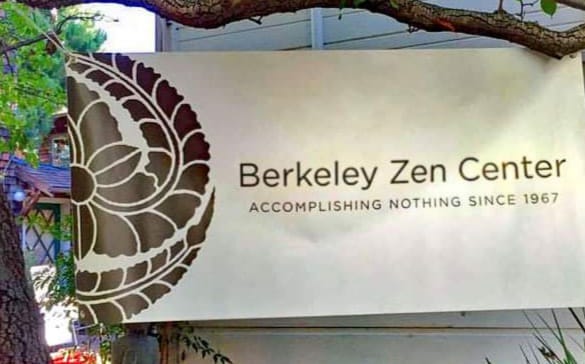
Chapter 10 from my first book, Bare-Bones Meditation: Waking Up from the Story of My Life, takes place in the 1980s, after I began practicing at the Berkeley Zen Center (where they have been happily “accomplishing nothing since 1967” — see photo above). It describes my first dokusan (or formal private meeting) with Sojun Mel Weitsman, who became my first real Zen teacher. Mel was the founding teacher and abbot of Berkeley Zen Center. He was a very tender-hearted, wise, grounded man with genuine humility. He came across as very ordinary, and in that, he was truly extraordinary. I continue to absorb and learn from his teaching and from the way he lived. This is Chapter 10:
What Is It?
I started sitting at the Berkeley Zen Center. One day Mel Weitsman, the abbot and teacher, passed me in the garden and said, “We’ve never talked.”
“Talked?” I said.
He told me that it was possible to meet with him, to discuss your Zen practice. So I signed up. Maybe he could tell me what I should do with my life.
The following week, I went in to see him at 5 o’clock in the morning. He was waiting for me in a tiny candlelit room with an altar. I was breathless. I bowed to him the way I’d been told I was supposed to, and sat down on the cushion opposite him. My heart was pounding, my throat was dry. I felt as though I were meeting God.
“How’s it going?” he asked.
I nodded nervously.
“What comes up when you sit zazen?”
“I think about the future a lot,” I told him. “I always do. I can’t decide what to do with my life.”
“Do you have to do something with it?”
“Well, I mean, I think about going to acupuncture school...or becoming a therapist...”
“What are you doing now?” he asked.
“I do massage. But, I mean, that’s probably crazy. I’m always worried about what people are thinking when they arrive for the first time and I answer the door! A one-armed masseuse, it sounds like a bad joke.”
“If you think you can do it, then they’ll think so too,” Mel said. “I don’t see a problem.” He smiled. “What else are you doing besides massage?”
“Oh, I’m writing a book. And I study karate. And I do photography. And political work sometimes, although I’m not doing very much of that anymore. I feel kind of scattered. I start things and don’t finish them.”
“You have to find the thing you really want to do,” Mel said, “the thing you enjoy most. The thing you can’t not do. And then you have to stick with it. And not give up, no matter what. You have to let go of the paths not taken, and really allow yourself to deeply penetrate the one you’ve chosen. Otherwise, you’re just skimming the surface, window-shopping, always avoiding what’s in front of you, imagining there’s some way out.”
“But how do I know which path to pick?” I asked him.
“It’s usually the one that’s easiest, most obvious, right in front of you,” he said.
Writing or sitting zazen came instantly to mind. “Maybe I should become a therapist,” I said aloud. “I keep thinking I need a career. Something substantial.”
“You have to make a choice and then commit yourself,” Mel said. “You have to burn all your bridges, so you can’t go back. Nirvana is seeing one thing through to completion. Otherwise, life just becomes a lot of mental ideas about an imaginary future. You need to come back again and again to your breath, to the day you are actually having. Not the day you wish you were having, or the day you think you should be having, or the day you know you could be having somewhere else tomorrow, but this day that you are actually having right now.”
“Jesus,” I thought. “This can’t be it.”
“Are you still holding out the hope that you’ll get there someday?” Mel asked. “That you’ll find your ideal life?”
“I know it’s impossible,” I replied, “but I’m still holding out the hope,” I admitted.
“Your meditation practice will teach you the impossibility,” he smiled. “Some people spend their whole lives looking for it, but never doing it,” he said. “What is it?” he asked.
I wondered.
“That’s your natural koan,” Mel told me later. “What is it? Keep asking that question, all the time. Don’t try to answer it. Just keep asking. What is it?”
What is it? …
All my life I’ve been waiting for something to happen.
“When thoughts come, you can invite them in,” Mel told us in one of his lectures, “but don’t serve them tea.” He smiled. “Zen teaches you how you think,” he said. “It’s about watching the movie that’s going on inside your head, the one you’re acting in, and beginning to see it for the first time. Be aware of your physical sensations, your breath, your thoughts. Don’t try to change anything. Just see it.”
He looked at us and paused for a long time. I heard the raindrops on the roof and the birds singing in the courtyard. I heard car tires on the wet street.
When you just sit there doing nothing, you discover that there is a tremendous amount happening: plans, memories, physical sensations, emotions, impulses, desires, likes and dislikes, fears, fantasies, judgments.
“In Zen,” Mel says, “we just watch. Just be aware.”
“Enlightenment isn’t about getting something,” he told us. “With any great Zen master, it’s not what they have, it’s what they don’t have.”
I loved the sense of freedom, the relief of finally just sitting down and doing nothing at all. Listening quietly for the first time. Simply being alive. Hearing the rain.
“You are perfect just the way you are,” Mel said to me, “but that doesn’t mean that there isn’t room for improvement. Each moment is perfect, but you don’t have to hold onto it.”
“I want you to be my teacher,” I told him.
“Thank you,” he said.
— from Bare-Bones Meditation: Waking Up from the Story of My Life
This is an except from the next chapter, Chapter 11:
I signed up for my first seven-day sesshin. A Zen sesshin is a kind of mind-washing, Mel told me. A whole week of meditation. The days are spent sitting zazen, doing walking meditation, bowing and chanting, working together in silence, eating formal meals in the zendo in an elaborate ceremonial fashion, and having private meetings with the teacher. Aside from these meetings, the ceremonies, and a daily lecture, there is complete silence for the entire week and no eye contact between participants. The schedule is compulsory and rigorous. You must sit, and you sit through pain or whatever arises, without moving.
So much communion exists without words or eye contact. I am struck by the intimacy I feel with these people, with the person who sits next to me for seven days.
In sesshin, we sit with our pain and do not move away from it. We sit with our desires and do not move toward them. We eliminate all the outward escapes from our suffering. We really get to know it. What is it? We watch the obsessive loops of our thinking. We eat in silence. Servers bring us food, bow to us, and bring hot water afterwards with which we wash our bowls. The smallest tasks become sacred. Washing our eating bowls. Folding our napkins. Form is not sacred, Mel says, but form allows the sacred to emerge.
It gets painful. My legs hurt, my back aches, my feet are cold, my eye itches. I don’t move when the pain comes. If I resist the pain, seeing it as something outside of myself that is attacking me, something I want to get away from, then it begins to frighten and overwhelm me. The only way through it is to be very still and open to it.
“It’s important to reach the point where you think that you can’t continue for another second,” Mel says, “and then it’s important to continue.”
“I’m having a crisis of faith in Zen,” I told him at one point. I had cramps and a headache, my back was killing me, and I didn’t feel like sitting in a freezing cold room at 4:30 in the morning trying not to move.
“There is no Zen,” Mel replied. “It’s what’s inside of you. Where’s your spirit?”
“I’m in pain,” I told him. “This feels like nothing but a crazy macho endurance contest.”
“Endurance is everything,” he told me. “It’s your ability to see things through to completion. We always want to go somewhere else or get something we don’t have. We think that if only we move to a new house or find a new job or a new girlfriend, or get enlightened, then we’ll finally be happy. But the trouble is, no matter where we go or what we do, we take ourselves along. And that’s the real problem. Here in sesshin we face that. We don’t move at all. The whole point of sesshin is to have no way out. Because if there’s a way out, we take it. This is where the buck stops. This is the last place. Here, we just have to settle in exactly where we are. Because really, this moment is all we ever have.”
“I can see the benefits of that kind of practice,” I began, “but—”
Mel cut me off. “Benefits, benefits,” he repeated with irritation. “No! Just do it! This isn’t about benefits. It isn’t about getting something or becoming somebody. It’s just this. Nothing else!”
I can’t imagine living without the idea of getting somewhere, or becoming somebody. I feel as if my mind will crack any second. But somehow I keep going. Days and nights go by. Watching for the thoughts to come up. And then noticing that they have already come and swept me away.
“What about the world situation?” I asked Mel.
“This practice will help us know what to do to save the world,” he told me. “We are the world.”
Mel says that small mind sees the enemy as outside of ourselves and conceives the answer as bigger and bigger guns. Big Mind sees the enemy in myself and myself in the enemy….
“Thank you all for making this great effort,” Mel said to us at the end of the sesshin. “It would be very hard to sit a sesshin alone.” His ears seemed extraordinarily large. There was a long silence. At last Mel spoke: “Life is one long sesshin from which there is no escape.”
— from Bare-Bones Meditation: Waking Up from the Story of My Life
A little bit about Mel
I was eventually, briefly, a resident at BZC. I moved on to other teachers, but stayed in touch with Mel. He died of cancer in 2021 at age ninety-one. His book, Seeing One Thing Through: The Zen Life and Teachings of Sojun Mel Weitsman, was published posthumously a few years later. It begins with a series of autobiographical memories and reflections going back to Mel's working-class boyhood in Los Angeles, his coming of age as an artist in 1950’s San Francisco, and his discovery of Zen through Shunryu Suzuki Roshi, who became Mel’s teacher. The larger portion of the book is a collection of Mel's wonderful dharma talks and his down-to-earth expression of "ordinary mind."
What Do We Really Want?
“What Do We Really Want” is the final subsection in Chapter 4, “The Long Road Home,” from my most recent book, Death: the End of Self-Improvement. It’s about what happened on another Zen sesshin back in the 1980s with another Zen teacher, Maurine Stuart. Maurine was a concert pianist before she became a Zen teacher. She taught at the Cambridge Buddhist Association in Massachusetts, but this sesshin took place at Green Gulch Zen farm in California. She knew she was dying of cancer at the time, but she was full of energy. Here it is:
What really matters? What do I most deeply want? These are wonderful questions to live with and explore. Many decades ago, probably in 1989, I attended a seven-day Zen sesshin, or meditation retreat, with the late Maurine Stuart, who was dying at the time from cancer. She gave me that question, what do you really want, as a koan—a question to work with on the retreat.
I spent many days obsessively thinking about the question, twisting and turning in mental anguish, trying to figure out what it was I really wanted. Did I want to stay with Zen or go back to the nontraditional approach I had been pursuing? Did I want to stay in California or move back to New York? Did I want to live in a big city or in the country? Round and round the mind went. What finally became crystal clear, in one of those magical moments of total clarity when the mind stops and the clouds part and you’re simply completely awake to the obvious, what finally became crystal clear is that what really matters, what I most deeply want, is to be fully present and awake right here in this moment, right now, just as it is.
And today, decades later, if I had to give one single key to awakening, it would be that it’s all about Now—not yesterday or tomorrow or forever after—but right here, right now. It’s not about some better or different experience, but rather, it’s here in the immediacy of this experience. And this experience is ever-changing, impossible to capture in any concept, label or storyline. It doesn’t hold still. We never step into the same river twice, and we’re never the same person from one instant to the next. Presence is alive and moving, yet always Here-Now.
When the attention isn’t lost in thought-stories, it doesn’t matter if I’m in the city or the country, if I’m working in an office or living at a Zen Center, if my bank account is big or small, if I’m partnered up or single, rich or poor, writing a book or taking out the garbage. The joy, the love, the freedom is in the presence, the aliveness, not in the particular circumstances or momentary forms that life is taking. All forms are beautiful! All forms are equally an expression of this aliveness, this seamless energy. And all of them are gone in an instant.
We humans spend so much precious time and energy trying to escape the Now. We think we want better weather, a nicer living situation, a different partner, more money, less fatigue, more sex, fewer wrinkles, a different job, more cooperative or successful children, whatever it is we think will make us happy. But every job, partner, location, living situation, and spiritual path has its upside and its downside. The weather is always changing and nothing stays the same. Trying to find happiness in a passing form is inevitably disappointing. That doesn’t mean we can’t enjoy the passing forms or that we shouldn’t try a different job. But if we think that any of this is what will truly, deeply satisfy the longing of the heart, we are always in for a disillusionment.
Maurine died in 1990 at the age of sixty-seven. Subtle Sound: The Zen Teachings of Maurine Stuart is a collection of her talks published posthumously.
A few words from another Zen teacher:
We do not see that our life right here, right now, is nirvana. Maybe we think nirvana is a place where there are no problems, no more delusions. Maybe we think nirvana is something very beautiful, something unattainable. We always think nirvana is something very different from our own life. But we must really understand that nirvana is right here, right now.
How is that possible? We can say that our practice is to close the gap between what we think our life is and our actual life… Or more to the point, how can we realize that there is really no gap to begin with?
In zazen [Zen meditation] we do not expect anything. Zazen is not a technique to achieve anything…
Thinking is an abstraction… And since we are born and die seven thousand times in one second, the conditions we think about are already gone. We are thinking about shadows…
— Taizan Maezumi Roshi, from Appreciate Your Life: The Essence of Zen Practice
from my website:
Perhaps what we most deeply want is to simply be here as we are, hearing the birds or the traffic sounds, enjoying a cup of coffee, thinking whatever thoughts are passing through, seeing whatever is being seen, being this breathing, sensing, awaring aliveness, just as it is—not needing anything more or less. Just this. Simple, simple, simple.
What seems to get in the way? Believing that "This isn’t it," that "I’m not okay," that "Something better needs to happen." Thinking that we are separate from the whole and in control, mistaking our conceptual maps for the living reality, resisting what is, seeking happiness somewhere else. But even all of this is nothing more than momentary thoughts and sensations. Nothing is ever really in the way of here-now-being.
We are like waves in the ocean—ever-changing, inseparable movements of a seamless whole that has no center and no periphery. When we imagine that we are separate, feelings of deficiency, dissatisfaction and uneasiness inevitably follow. We search for certainty and something to grasp. But in holding on to nothing at all, there is immense freedom.— from www.joantollifson.com
Closing Words
Although I had a significant lightbulb moment of insight on that sesshin with Maurine Stuart back in 1989, old habits die hard. It took me many decades for this simple truth to fully sink in, that all we have is right here, right now. I spent many more years still seeking a big awakening event until it got clearer and clearer that this search was all about “me,” the illusory separate self who always feels deficient, and an imagined future event that never arrives. It was a distraction from the only life I actually had, which is always NOW. Thankfully, that search fell away, and I’m no longer spending huge amounts of time daydreaming about a better future.
While Zen practice (or any spiritual path) has many potential benefits, if we’re doing it in a result-oriented way in order to attain benefits, we’re missing the mark. As Mel told me many decades ago, “This isn’t about benefits. It isn’t about getting something or becoming somebody. It’s just this. Nothing else!”
Paradoxically, because we humans can become so confused by our complex dualistic thinking, it often requires a long pathless path and an immense effortless effort and much exploration to undo the knots of confusion, to relax and open the bodymind, and to realize (make real in our own life) the reality of no separation, nowhere to go, and nothing to accomplish. And although this can take many decades, it can only ever happen in the timeless immediacy of NOW. And there is no permanent end, at least in my experience, to delusion. We wake up again and again, and always only NOW.
Enlightenment or freedom or liberation is simply being awake NOW. Not yesterday, tomorrow, or forever after, but NOW. And there is no owner in enlightenment. It’s not a possession, an attainment, a personal accomplishment, a merit badge or anything of the sort. There is no separate “me” who is enlightened, and the very notion of a “permanently enlightened person” is an oxymoron, a delusion from which enlightenment awakens (NOW).
As long as we are looking for enlightenment or nirvana or liberation, we are over-looking it.
Everything is one undivided whole, and nirvana is not other than samsara, but at the same time, there is an immense difference between enlightenment and delusion, or between the freedom and peace of nirvana and the suffering and confusion of being lost in samsara. So, yes, there is a path and a journey of transformation, but it’s not taking us somewhere else. It’s about waking up to what is, right here, right now. Being here now. Being present. Being this open awake presence that has no inside or outside, in which the body-mind-world is one whole undivided happening. Being here with whatever shows up, samsara or nirvana.
There is no end to this awakening journey, just as there is no end to here and now.
There are so many seeming paradoxes when we try to express all of this, but they are only paradoxical to the thinking mind. Presence itself couldn’t be simpler.
Sometimes we use the image of breaking out of a shell: really there is no shell to break out of, and yet we create and seem to be in a shell. Being in this shell is being in hell, so we speak of breaking out of the shell. Of course, while we are in hell, living in hell is our practice. In fact, being present in hell is breaking out of hell.
—Zen teacher Elihu Genmyo Smith
Finally, I just watched this very beautiful video of a Mother’s Day talk by Jiryu Rutschman-Byler, the current abbot of Green Gulch Zen Farm, someone I very deeply love whose talks I’ve shared several times before. This one is a gem:
My books in the order they were written:
Bare-Bones Meditation: Waking Up from the Story of My Life
Awake in the Heartland: The Ecstasy of What Is
Painting the Sidewalk with Water: Talks and Dialogues about Nonduality
Death: The End of Self-Improvement
People often ask me which book I'd recommend first, and I can’t say. They’re all quite different. Nothing to Grasp is a concise articulation of my essential message. Painting the Sidewalk with Water is mainly a collection of talks and dialogs transcribed from my public meetings in the early 2000s. My first book, Bare-Bones Meditation: Waking Up from the Story of My Life, is a spiritual memoir that focuses largely on my work with Toni Packer, but also includes working with my first Zen teachers, Mel Weitsman and Charlotte Joko Beck, and later discovering Advaita through Nisargadatta, Jean Klein and Gangaji. Awake in the Heartland and Death: The End of Self-Improvement both combine personal stories with expository and poetic prose about nonduality. Death: The End of Self-Improvement, in addition to being about nonduality, is also about aging, dying, and going through cancer.
All my books come from a nondual spiritual perspective, and they all explore questions of identity, free will, addiction, suffering, transformation, awareness and the nature of experience. All my books point to the simplicity and immediacy of right here, right now, just as it is, and they all invite a kind of meditative exploration that is direct, non-methodical, awareness-based and not result-oriented. I write from my own direct experience and insight, but my perspective has been informed by my engagement with Buddhism, Advaita, Christianity, Sufism, radical nonduality and nontraditional inquiry.
Love to all…
“Accomplishing nothing since 1967” may secretly be one of the healthiest spiritual slogans ever written.
Modern spirituality keeps getting hijacked by optimization culture. People turn meditation into emotional CrossFit for becoming a more efficient ego. Meanwhile these old Zen teachers keep pointing back to the scandalously simple thing nobody wants to hear: this moment is already your life.
Thank you! My heart is full and empty at the same time reading this💗