
Darkness
“Stop, Drop, and Be Held in the Dark”

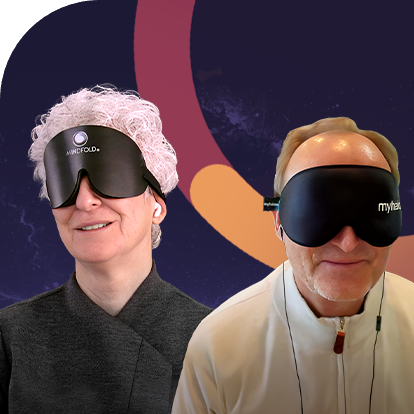
“Stop, Drop, and Be Held in the Dark”
A friend sent me this link to a Sounds True podcast of Tami Simon in conversation with Andrew Holecek, author of Total Eclipse of the Mind, about “the ancient practice of full immersion in complete, sealed darkness.” (They wear dark masks for part of the conversation). Andrew is “an interdisciplinary scholar, author of ten books, longtime practitioner of Tibetan Buddhism,” and “after fifty years of meditation, psychedelic exploration, and completing a traditional three-year Tibetan retreat, Holecek calls [immersion in darkness] easily the most transformative practice he has ever done.”
I listened to this conversation and was blown away. I'd heard before of people going on extended dark retreats, I know they sometimes do this in Tibetan Buddhism, but that had always sounded totally unappealing to me. One teacher I spent time with on Zoom, the late Peter Brown, sometimes recommended time in the dark to people, but not in the way Holecek does, at least not that I heard, so I was never moved to try it. But this conversation moves me to try it, not for long stretches of many days as some people do, but for short periods at home. The conversation alone had such an impact on me that I want to share it with all of you.
In their conversation, Tami and Andrew explore:
What actually happens to the mind in extended darkness—and the neurological science behind why it’s so transformative
The descent of the mind through conscious, subconscious, and collective unconscious layers—and what waits at the bottom
Dark retreat as a “sober psychedelic”: how the brain generates its own endogenous DMT in extended darkness
The practice of enantiodromia—when extreme contraction suddenly flips into extraordinary openness
How to work with panic, trauma, and unwanted experience using the “reverse meditation” principle: feel it, but don’t feed it
Why appearances don’t matter in the dark—and why so many people emerge in tears, feeling safe and held for the first time
The four-step process for integrating darkness into daily life, from sleep masks to dedicated dark rooms
Roshi Joan Sutherland and The Zen of Endarkenment
Listening to this conversation with Andrew Holecek brought to mind the Zen teacher Joan Sutherland, who notes that “about 96% of the universe is made up of dark matter and dark energy,” and who considers both enlightenment and endarkenment essential in the “lifelong process” of awakening. Enlightenment is “the brilliant illumination that lifts us out of the suffering world,” and endarkenment is “the radiance of the deeps that lets us find home in the world… the heart that breaks open to life, rests comfortably on the unfathomable mystery of existence, and is easy with uncertainty, complexity, and what courses underground.” She writes: “Everything comes from the same dark, everything is filled with the same light. Which isn’t to say that everything is completed just yet; there is still more horror and viciousness than it’s possible almost to bear. But aren’t those the very things most in need of inclusion in this agonizingly slow, grievously uneven awakening?”
Joan tells us that, “In the eighth century, a new kind of Chan Buddhism developed in response to a cataclysmic time in Chinese history: in the space of ten years, two-thirds of the population died of rebellion, invasion, famine, and disease… A few Chan innovators had a fierce desire to leap out of the usual ways of doing things and into new territory—not to escape the catastrophe looming around them, but to more fully meet it… Chan practice wasn’t about getting free of the world; it was about being free in the world. How do we fall willingly into the frightened, blasted, beautiful, tender world, just as it is?... This true self you are looking for, [the old Chan masters] said, is not just here, in your own heart-mind, but everywhere. Everything you see is buddha nature; everything shines with that light. Everything you see is you—and this at a time when what you saw included blighted fields, refugees starving by the roadside, deserted towns. There’s something so moving about the large and generous spirit of these [Zen teachers] who responded to the devastation around them by saying, This is all me. This is all you. They showed that the way to come to terms with life’s pains is not by turning away from them but by moving deeper into life.”
There are some marvelous videos that you can find on her website, in one of which she says: “About 96% of the universe is made up of dark matter and dark energy,” and she asks, “How do I include that 96% of the dark? What if there’s this whole underground thing happening? What’s it like to be in that moment?” She says, “I tend now to think of a vast original dark that is nondual and that holds the light and the dark within it… this vast dark and the manifest lit world that comes out of that… There is this great dreaming going on underneath everything all the time.” She speaks of “learning to rest on that mystery, lie back on that fathomless sea… to come to rely on the fact that there’s nothing to rely on… to feel the beauty of that and to love that mystery, in some ways to become devoted to that mystery.” And she speaks of “our willingness to get our hearts broken and to stay broken, in the understanding that the broken heart is open and connected.”
A Semi-Retreat in the Midst of Daily Life
I’ve been on a kind of semi-retreat at home this week, inspired by my friend the satsang teacher Dorothy Hunt, who is leading an actual in-person retreat this week—I’m still going shopping, getting a haircut, having physical therapy, working out, going to a doctor’s appointment, holding a Zoom meeting, dining with friends, answering email, even watching a few episodes of a Hulu series on my iPad, and now listening to Andrew and Tami and preparing this Substack—but in between all this activity, I’ve spent less time online and more time than usual sitting in silence, doing nothing, both in my home and also out in nature. It’s been refreshing, and I’m heading back into that silent stillness now and for the rest of the day until dinner. And hopefully for most of tomorrow as well.
Love to all….
Joan, sounds like you're recovery is going well. Very glad to hear.
This post brings to mind "The Tears of Things: Prophetic Wisdom for an Age of Outrage," a book published last year by the contemporary Christian mystic Richard Rohr.
Rohr identifies a general pattern among the "mature" prophets (e.g. Isaiah, Jeremiah): their "ministries" begin with anger over blatant injustices, they mature as they move into grief and lamentation, and then ultimately culminate in a non-dualistic unconditional love that embraces brokenness without judgment.
The broad theme, as I read it, is that suffering is an intricate aspect of the spiritual journey, it's how we "fall willingly into the frightened, blasted, beautiful, tender world, just as it is?"
Something like this view first occurred to me on the passing of my grandmother in the 1980s (I was in my thirties). She had been sick for sometime, so her passing was expected.
Nevertheless, upon entering the funeral home and seeing her lying in state, to my complete surprise, I burst into tears as I was overcome with a tidal wave of emotion - beyond anything I could have imagined. But instead of wallowing in the loss, I was blessed immediately to recognize my outburst as an absolutely beautiful expression of the depth of love I felt for this women. Two sides of the same coin: grief/love.
With love...
I had actually listened to that podcast because I follow Tami Simon, and I, too, found myself attracted to participating in a dark retreat. Sounds like it could be quite revealing and even healing